based on Kelley Ross's work Meaning and the Problem of Universals
| Necessity | Contingency | Comment | extended comment |
|---|---|---|---|
| Pietative | Ur-Contingency | Holy and arbitrary | |
| Optative | Arbitrary | Beauty | |
| Hortative | Private | Ethics, good and bad | |
| Jussive | Permissible | Law and Contract | |
| Imperative | Purposive | Morality, right and wrong | Transition to positive transcendence begins here |
| Conditioned | Unconditioned | Natural Laws | |
| Perfect | Imperfect | Facts | |
| A Priore | A Posteriore | Mathematical truths | |
| Analytic | Synthetic | 1+1=2 |
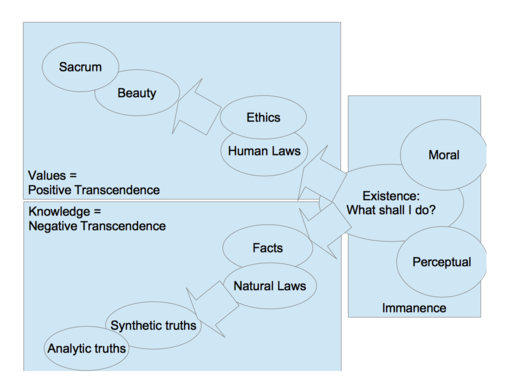
It is suspected that the highest and lowest levels are the same thing, that the ultimately holy has in its hands the basic analytical building blocks of reality that we sense as unsubvertible.
May 2005
The 4 lower levels of necessity are arrived at via so-called negative transcendence. Negative transcendence is the process of reducing the obfuscating input in order to reveal the essence at a given level. The upper 5 are levels of positive transcendence. The Conditioned truths are truths of scientific nature - ideas and theories explaining observed facts and experiments. Interesting thing occurs while moving above this level. I would like to call it - the Romantic Conversion. At this point the mind starts looking at the world with a purpose of adding to being rather than reducing. It is a grandiosity of the inquring mind to aspire to constructing value and thus adding to being on the basis of knowledge constructed through negative transcendence. Reductive Rationalism giving rise to Romantic expansionism. Ross Kelly explains how this happens in his observations on pleasure and pain as cases of sensation:
Pleasure and pain can be said to represent the positive transcendence of that fragment of external existence, my body in whole or part, that corresponds to my internal existence. Pleasure and pain are free of the form of intentionality in the sense that they are in no way cognitive sensation...
and
Following Nelson pleasure and pain will be call "intuitive value" in that they are present to consciousness without the mediation of thought and reflection. There is no cognitive dimension to intuitive value, however, apart from phenomenal objects, and there is thus no special mode of necessity to be associated with their ontological ground.
To the latter quote I should add that it means also that sensation, pleasure and pain being the most significant examples, is prior to perception which already contains the seed of cognition - namely intelligence.
I would like to express the juncture point between negative and positive transcendence differently. All sensation and all pleasure and pain converge in the physical body. Schopenhauer called the body - objectivity of the will. I would call it the commanding presence of the body.
The basic experience of every human being is that of possession and control of one's body. One's own body is more than a mere phenomenon, even though it can be experienced and researched as such, it remains the main locus of one's vitality. This observation is shared among all people - even those who assert belief in the soul have to admit that the body imposes itself very forcefully and imperiously as the reality of being alive. We experience the body as the objective reality of living even when various religious teachings exhort us to suspend belief in the reality of the body and entrust all our life to an intangible soul. We all know that it is difficult, but it is also intellectually dishonest to derogate the commanding presence of the body.
August 2009